
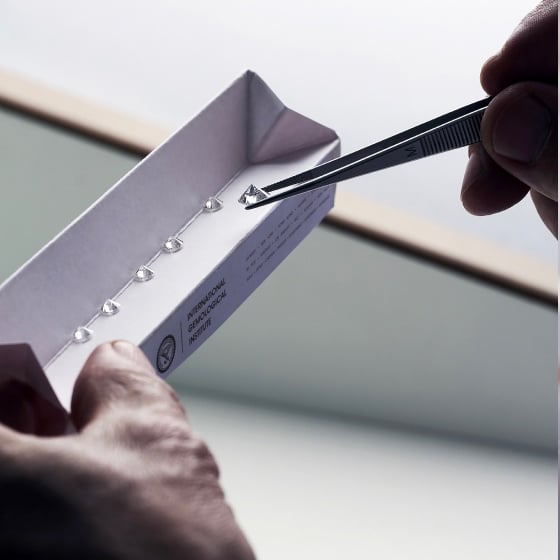
Most diamonds of gem quality used in jewelry vary in shade from completely colorless down to a visible yellow or brown tint.The rarest and most expensive are diamonds in the colorless range graded D,E and F on a scale that descends to Z. Diamonds with more color than Z, or in other shades such as orange, pink, blue, etc. are classified as “Fancy Colored Diamonds” and are graded on the IGI Colored Diamond Report.To determine the correct color, all submitted diamonds are compared to an internationally accepted master set of stones, the colors of which range from D, or colorless (the most sought after) to Z, the most yellow/brown – aside from “fancy” yellow or brown.
The 4Cs: Diamond Color
Diamond color is a key factor in determining a diamond’s visual appeal and value. Most of the world’s diamonds are graded on a scale of colorless to light yellow or light brown. Other hues are graded on a different scale and called Fancy Colored Diamonds.
Understanding the subtleties of diamond color can provide greater appreciation for each exquisite gem and is a fundamental choice when selecting a diamond best suited to the wearer. Whether colorless or displaying a slight tinge, the details of diamond color showcase the unique characteristics of each stone.
Most diamonds of gem quality used in jewelry vary in shade from completely colorless down to a visible yellow or brown tint. The rarest and most expensive are diamonds in the colorless range graded D,E and F on a scale that descends to Z. Diamonds with more color than Z, or in other shades such as orange, pink, blue, etc. are classified as “Fancy Colored Diamonds” and are graded on the IGI Colored Diamond Report. To determine the correct color, all submitted diamonds are compared to an internationally accepted master set of stones, the colors of which range from D, or colorless (the most sought after) to Z, the most yellow/brown – aside from “fancy” yellow or brown
Diamond Color Charts
IGI assigns a color grade for diamonds in the D-Z range with the diamond face-down and viewed through the pavilion, allowing for precise and unbiased evaluations of diamond color. This is necessary because the size, shape, cut quality, and potential fluorescence of a diamond can influence the perceived diamond color when the stone is viewed face-up. In fact, lighting, choice of mounting, and even the hue of the viewer’s clothing can impact the perceived color. IGI employs the most neutral environment possible to ensure accurate and consistent results across the diamond color scale. This meticulous process guarantees that each diamond is correctly graded according to its specific aesthetic, offering consumers confidence in the value of their selection. Below is a brief look at the layout of the diamond color scale:
- DEF: These are the highest grades on the diamond color scale, defined as completely colorless. Ideal for buyers seeking the ultimate, clean, “icy white” brightness which has become synonymous with premier diamonds.
- GHIJ: These diamonds display near-colorless quality with minor hints of warmth, often imperceptible to the untrained eye, offering excellent value.
- KLM: Features slight warmth to the color that is noticeable but considered charming by many; suitable for those who prefer subtle personality in their diamonds.
- N-Z: Dominated by very light to light yellow or brown hues, these diamonds offer affordability, perceived character, and the opportunity for creativity in jewelry design.

D-F
Colorless

G-J
Near Colorless

K-M
Faint Color

N-R
Very Light Color

N-R
Light Color
Learn With Videos
Diamond Color Scale
The diamond color scale provides a consistent method for grading the color quality of diamonds, ensuring a globally recognized standard. Diamonds graded D are considered completely colorless. Diamonds graded E and F, with distinctions that are barely detectable, are also categorized in the colorless range. Many consider diamonds graded G and H on the diamond color scale to offer a great balance of quality and value, since they are closest to colorless. Diamonds graded I and J are also near-colorless, with warmth that may only be visible to experts. Moving down the diamond color scale, stones graded K and below exhibit increasingly noticeable color, which may be used to create unique and captivating pieces for wearers who appreciate a broader spectrum of hues.
- D Colored Diamonds: Unrivaled purity on the diamond color scale, and icy white brilliance for connoisseurs seeking the most pristine diamonds.
- E Colored Diamonds: Next in the colorless range, with minute color nuance compared to D, offering similar purity and affordable luxury.
- F Colored Diamonds: Still in the pure, colorless range, with nuance which barely separates it from those counterparts above.
- G Colored Diamonds: Nearest to colorless, maintaining similar appearance with extremely nuanced tone, often undetectable once mounted.
- H Colored Diamonds: Often considered an ideal balance of cost-effectiveness and visual appeal with high near-colorless quality.
- I Colored Diamonds: Show some nuanced warmth that’s low-key and gentle, suitable for strong or delicate designs in all metal colors.
- J Colored Diamonds: Retain appreciable charm with unobtrusive hue which may be perceived as a warm personality.
- K Colored Diamonds: Notable warmth that nicely engages with innovative jewelry settings.
- L Colored Diamonds: Distinct yellow tint blends with creative style, permitting bold artistic expression.
- M Colored Diamonds: Display noticeable warmth for bespoke and compelling personal pieces.
- N-Z Colored Diamonds: Evoke character and affordability, fitting non-traditional tastes and allowing imaginative possibilities.
Diamond Color FAQS
- What is the real color of diamond?
- There is not one real diamond color, there are many, most of which span a range of colorless to light yellow or brown, as well as fancy colored diamonds in all hues.
- There is not one real diamond color, there are many, most of which span a range of colorless to light yellow or brown, as well as fancy colored diamonds in all hues.
- What are the grades of diamond color?
- In the normal range the IGI report identifies the specific diamond color grade on a scale of D (colorless) to Z (light yellow or brown).
- In the normal range the IGI report identifies the specific diamond color grade on a scale of D (colorless) to Z (light yellow or brown).
- Which color of diamond is the best?
- The best diamond color depends on personal preference, however diamonds graded D are considered the pinnacle, and D-E-F paired with VVS+ clarity are known as “collection category” diamonds.
- The best diamond color depends on personal preference, however diamonds graded D are considered the pinnacle, and D-E-F paired with VVS+ clarity are known as “collection category” diamonds.
- What is the rarest diamond color?
- Red is the rarest diamond color, highly prized for its unrivaled uniqueness and extreme scarcity.
- Red is the rarest diamond color, highly prized for its unrivaled uniqueness and extreme scarcity.
- What causes color in diamonds?
- Diamond color results from structural irregularities or trace chemicals like nitrogen, which absorb some portions of light being returned through the gem and transmit others.
- Diamond color results from structural irregularities or trace chemicals like nitrogen, which absorb some portions of light being returned through the gem and transmit others.
- What are the 4 colors of diamonds?
- The popular “4Cs” of diamonds are Carat weight, Color, Clarity and Cut. When you combine the various colored hues with different tones and saturations there are literally hundreds of colors of diamonds.


